HOODED EYES
Excess skin draping from the brow over the upper eyelid crease. Honest breakdown of the three conditions most pages confuse (native hooded vs. dermatochalasis vs. ptosis), self-assessment from a photo, sex-differential perception, makeup techniques that actually work, and a real comparison of every fix from drops to blepharoplasty.
- →Hooded eyes = excess skin from the brow bone obscuring the upper eyelid crease.
- →Three conditions get confused: native hooded (genetic) vs. dermatochalasis (aging) vs. ptosis (lid-margin droop, different fix).
- →Sex-differential perception: for men, hooding is part of the "hunter eyes" aesthetic. For women, the conventional standard favors visible lid.
- →Non-surgical fix: adapted makeup technique (shadow above the natural crease), Upneeq drops, brow Botox.
- →Surgical fix: upper blepharoplasty is the gold standard. Add brow lift if brow has descended.
Four Conditions Most Pages Confuse
These get conflated constantly — including by some doctors and almost every general-audience page on the internet. They have different causes and different fixes. If you're going to consult a surgeon, knowing which one you have changes the conversation.
Native hooded eyes
You inherited extra skin on your upper lid. Nothing wrong with the muscles — the lid lifts normally. Tends to run in families. For looksmax purposes: paired with a positive canthal tilt, this is what creates the 'hunter eyes' look.
Age-related hooding (dermatochalasis)
Looks the same as native hooded eyes (extra upper-lid skin) but caused by your skin losing collagen and elastin as you age. Usually shows up in your 40s-50s. Sun exposure speeds it up. Often combined with the brow dropping over time, which makes it worse.
Droopy eyelid (ptosis)
This is NOT hooding — it's a different problem. Your eyelid edge itself drops down (not just the skin above it) because the muscle that holds your lid up has weakened. Can cover part of your pupil and mess with your vision. Sometimes affects only one eye. Can be a sign of an underlying nerve or muscle condition, so see a doctor if you suspect this.
Brow drop (brow ptosis)
Your eyebrow has dropped over time, pushing extra skin onto the lid. This makes it look like hooding but the actual cause is the brow position, not the lid skin. Common in older patients. Important to spot before any surgery: lift your brow with your finger — if the hooding shrinks a lot, this is your real issue.
Hooding Across The Spectrum
Three eye-area drawings. Compare your own to find roughly where you sit. The key feature is how much skin sits over the upper lid.
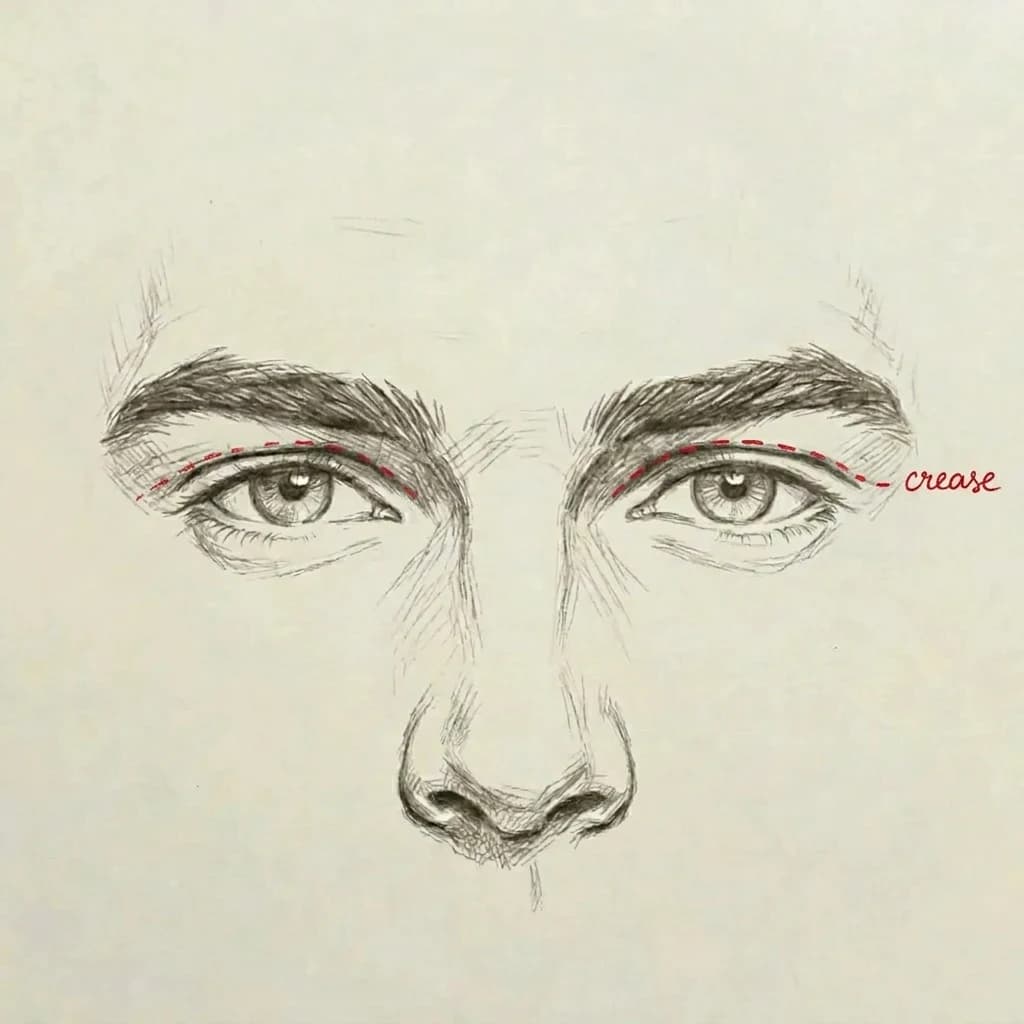
Upper lid space is fully visible. The eyelid crease is clearly shown above the lashes. No skin draping down over the lid.
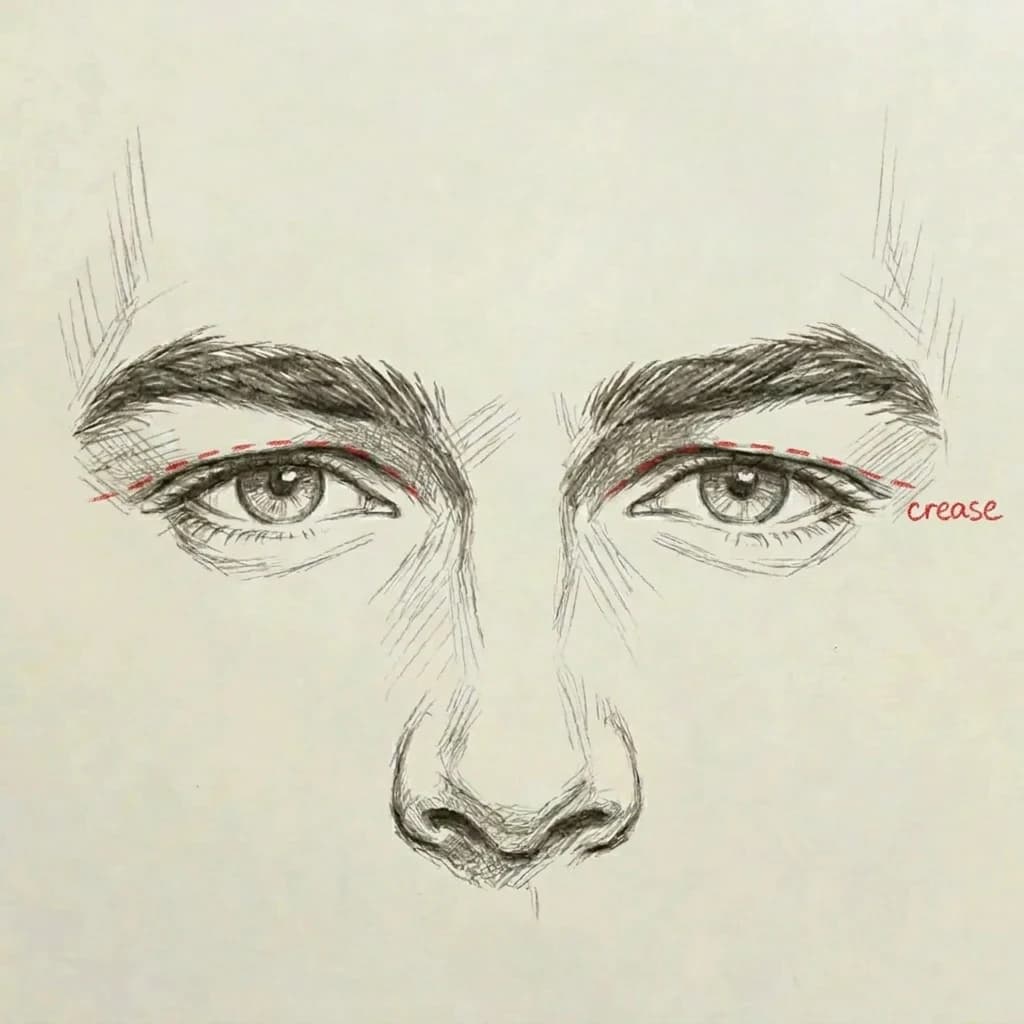
Some skin from the brow bone hangs over the outer part of the upper lid. The crease is partly hidden but you can still see some of the lid space. Common with mild aging.
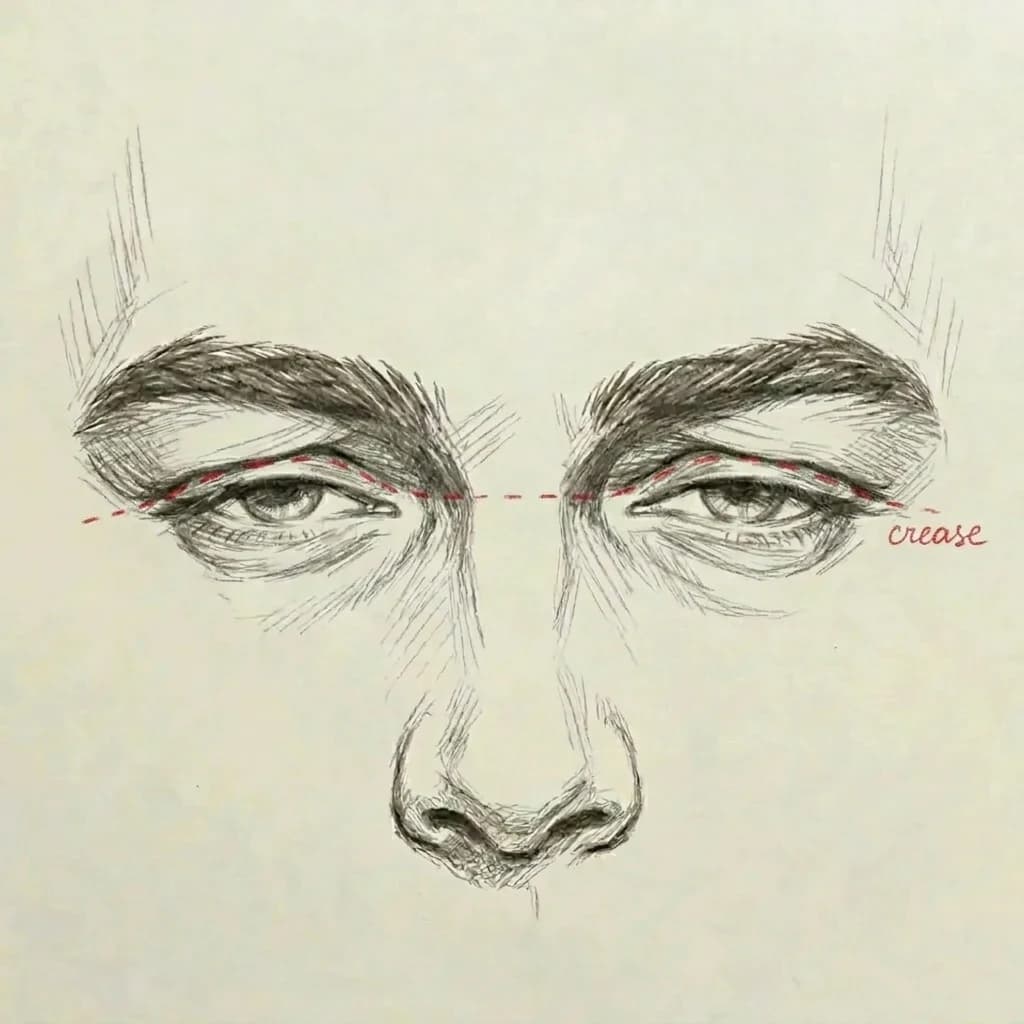
Skin from the brow drapes down close to the lashes. The eyelid crease is completely hidden. Very little visible lid space. Heavy / textbook hooding.
Self-Assessment
Four checks. Three minutes. Free.
Mirror test
Look in a mirror with your eyes open and relaxed. Look straight ahead. If the skin under your brow bone covers most of your upper eyelid — and you can't really see your eyelid crease — you have hooded eyes. If the skin almost touches your lashes, the hooding is heavy.
Make sure it's not droopy eyelids (ptosis)
Look at where your eyelid edge sits — the part where your lashes grow. In hooded eyes, the lid edge is in a normal place; only the skin above it sags. In ptosis (droopy eyelid), the lid edge itself drops down and can cover part of your pupil. Ptosis can affect your vision; regular hooding usually doesn't. If your pupil is partly covered by your eyelid, see an eye doctor — that can be a sign of a nerve or muscle issue.
Check if your brow has dropped
Look in the mirror, then gently lift your brow with your finger to where it would naturally sit. If the hooding shrinks a lot, the real cause is your brow dropping (called brow ptosis), not skin on your lid. This matters for surgery — eyelid surgery alone won't fix this, and can sometimes make it look worse.
Make sure it's not just deep-set eyes
Deep-set eyes sit further back in your skull under a strong brow bone — they look shadowed, but the lid space is still visible. Hooded eyes have skin draping over the lid. Lots of people have both. A side-profile photo shows the difference clearly: deep-set = eye sits back; hooded = skin hangs over.
Our free Hunter Eyes Test scores 5 components from a single photo: canthal tilt, lid exposure (where hooding shows up), socket depth, almond ratio, and brow-to-eye distance. 0-100 hunter score with a 5-tier verdict.
Hooded Eyes On Men vs. Women
People react to hooded eyes very differently depending on whether you're a man or a woman. Most pages on the internet pick a side — either treating hooding as "a problem to fix" (women's beauty content) or "a feature to lean into" (men's looksmax content). The truth is both audiences exist and they want different things.
In male looksmax culture, hooding plus a positive canthal tilt makes up the "hunter eyes" look — comes across as intense, dominant, masculine.
Often cited: Robert Pattinson, Leonardo DiCaprio, Chris Hemsworth, Tom Hardy. Don't try to fix it — lean into it.
Traditional Western beauty standards favor open, visible upper lids with a clear crease. That's why most eyelid surgery patients are women and why most hooded-eye makeup tutorials are about opening up the eye area.
But also: Jennifer Lawrence, Blake Lively, Selena Gomez, Megan Fox, Lily Collins, Adriana Lima — all have hooded eyes and are widely considered beautiful. The standard is loosening.
Honest disclaimer
A 2023 study (PMC 10079083) found no clear link between specific eye-shape measurements (including how much of the lid is visible) and how attractive people are rated. So the men-vs-women framing above is more about cultural perception than proven science. Treat it as "what people commonly think" — not "what research has proven."
What Causes Hooded Eyes?
Five real causes ranked by impact.
1. Genetics (native hooded)
dominantInherited. Extra upper-lid skin you've had since you were young — nothing wrong with the muscles. Runs in families along with other inherited eye-area features (like canthal tilt, brow position, and eye spacing).
2. Aging
very strongYour skin loses collagen and elastin over time, and fat shifts around your eye area. Usually shows up in your 40s-50s. The most common reason adults look into eyelid surgery — and often combined with the brow dropping at the same time.
3. Your brow has dropped
commonly missedYour eyebrow has dropped, pushing more skin onto your lid. Often the real cause in older patients who think it's just lid skin. Important to spot before any surgery — eyelid surgery alone won't fix this, and can sometimes make it worse. Quick test: lift your brow with your finger. If the hooding shrinks a lot, this is your real issue.
4. Sun damage
acceleratorSun exposure speeds up aging. UV breaks down the collagen and elastin in the skin around your eyes, making hooding show up sooner. Sunscreen and sunglasses help prevent it.
5. Injury or medical treatment
rareHead injuries, chemotherapy, or radiation can speed up aging around your eyes. Uncommon, but worth thinking about if your hooding showed up suddenly or only on one side.
Non-Surgical Options (Ranked)
Five interventions, ranked by visual effect. None change underlying anatomy — they change how it reads.
Makeup that actually works
very effectiveThe catch: most eyeshadow tutorials put color in the crease — but hooded eyes hide the crease. Instead, apply your transition shade ABOVE the natural crease (where the brow-bone shadow falls), not in it. Blend upward and outward. Keep eyeliner thin at the lash line — thick liner disappears under the hood. Wing the liner past the outer corner. Tight-line the inside of your upper lash line for definition without using up visible lid space.
Brow grooming + lifting the arch
moderate effectA slightly higher brow arch creates more visible space between your brow and your lashes. For women: shape the arch a bit higher. For men: clean the line above the brow to define the arch without thinning it. Visual change only, no structural fix.
Upneeq prescription drops
modest, temporaryFDA-approved eye drops (oxymetazoline 0.1%). Officially for droopy eyelids, but doctors sometimes prescribe them for mild hooding too. They stimulate a tiny muscle in your eyelid to give you a 1-2mm lift. Lasts 6-8 hours per dose. Requires a prescription. Not a permanent fix — daily use only.
Botox brow lift
modest, temporaryTargeted Botox injections into the muscles that pull your brow down can give you a small 'chemical brow lift' — usually 1-2mm. Lasts 3-4 months. Make sure you go to an experienced injector — bad placement can change your expression in weird ways.
Lower body fat (for men)
helps the surrounding area, not the hooding itselfCuts down on puffiness around your eyes. Doesn't change the hooding itself, but cleans up the surrounding eye area. For men: don't fight the hooding itself — it's part of the hunter-eye look. Just reduce the puffiness around it.
Surgical Options
Three procedures, three different best-fit patients.
Upper eyelid surgery (blepharoplasty)
The surgeon removes the extra upper-lid skin — sometimes a bit of muscle and fat too. The cut goes right in your natural eyelid crease, so the scar is hidden. Outpatient procedure, 1-2 hours, done under local anesthesia with sedation. Recovery: bruising and swelling peak at 2-3 days, mostly gone by 10-14 days. Most people are back to normal activity in 1-2 weeks. Full healing takes 2-3 months.
What the research shows: a 348-patient study found big improvements in how patients felt about their eyes, their confidence, and their social life at 3 months — and those gains held through 12 months. By 12 months, 89% said the scar wasn't visible, 85.6% had no dry-eye issues, and 91.7% had no trouble closing their eyes.
Brow lift
This is the right fix when your brow has dropped — that's the real cause behind what looks like hooding. Quick check: if your brow sits at or below the bony ridge above your eye, brow ptosis is part of the picture. Sometimes done alone, sometimes combined with eyelid surgery. The combined version often gives better long-term results than either one alone.
Ptosis surgery (different problem)
If you actually have ptosis (a weak lifting muscle making your lid edge drop), regular eyelid surgery WILL NOT fix it. You need a different procedure to tighten the muscle. If your pupil is partly covered by your eyelid, you likely have ptosis, not hooding — see an eye doctor before any cosmetic surgery. If it's affecting your vision, insurance usually covers the procedure.
Score Your Whole Eye Area
Hooding is one of 5 components in our Hunter Eyes Test. Free, 60-second AI scoring across canthal tilt, lid exposure, socket depth, almond ratio, and brow distance — with a 0-100 hunter score and 5-tier verdict.
FAQ
What are hooded eyes?+
Excess skin from the brow bone draping over and partially or fully obscuring the upper eyelid crease. When you look straight ahead with relaxed eyes, the crease is hidden by the overhanging skin. The lid is still there underneath — distinguishing hooded eyes from monolids (which lack a crease entirely). Hooded eyes can be native (genetic, present from youth) or acquired (age-related skin laxity, called dermatochalasis).
How do I tell if I have hooded eyes?+
Mirror test: look at yourself with eyes open and relaxed, looking straight ahead. If the skin below your brow covers all or most of your upper eyelid and you can't see your crease, you have hooded eyes. If you can see your full lid space and crease, you don't. Photo test: a profile shot also reveals lid skin overhang. Most people are clearly one or the other; borderline cases can have one hooded eye and one open lid (asymmetric hooding is common).
Hooded eyes vs ptosis — what's the difference?+
Two totally different things people mix up all the time. In hooded eyes, only the skin above your lid sags — the lid edge where your lashes grow is in its normal place. In ptosis (droopy eyelid), the lid edge itself drops down, sometimes covering part of your pupil. Ptosis is caused by a weak lifting muscle; hooded eyes are caused by extra skin. Important: standard eyelid surgery fixes hooded eyes but does NOT fix ptosis — that needs a different procedure to tighten the muscle. If your pupil is partly covered by your eyelid, see an eye doctor before considering any cosmetic surgery.
What causes hooded eyes?+
Five real causes: (1) genetics — the dominant cause for native hooded eyes, runs in families; (2) aging — collagen and elastin decline plus fat compartment redistribution, becomes noticeable in 40s-50s; (3) brow ptosis — your brow descending pushes more skin onto the lid; (4) UV / sun damage accelerates the aging mechanism; (5) trauma or medical treatments (chemo, radiation) can cause acquired hooding. Most cases are genetics + aging combined. Brow descent is a frequently overlooked contributor in older patients.
Are hooded eyes attractive?+
Depends on who you are. Quick honesty check: a 2023 study found no clear link between specific eye-shape measurements and how attractive people are rated, so the claim 'hooded eyes are attractive' isn't really proven by research — it's more of a cultural thing. In male looksmax culture, hooding plus a positive canthal tilt makes up the 'hunter eyes' look — read as intense, dominant, and masculine. Examples often cited: Robert Pattinson, Leonardo DiCaprio, Chris Hemsworth. For women, traditional beauty standards favor open, visible upper lids — which is why most eyelid surgery patients are women and most makeup tutorials are about opening up hooded eyes. That said, modern beauty culture has been more accepting — Jennifer Lawrence, Blake Lively, and Selena Gomez all have hooded eyes and are widely considered beautiful.
Hooded eyes vs deep-set eyes — what's the difference?+
Different anatomical features that often coexist. Deep-set eyes are positioned further back in the skull, recessed under a prominent brow ridge — they look shadowed but the lid may still be fully visible. Hooded eyes have excess skin from the brow bone draping over and obscuring the lid. Many faces have BOTH features. The looksmax-ideal 'hunter eyes' actually involves deep-set + hooded together. See our deep-set-eyes page for that deeper dive.
How do you fix hooded eyes without surgery?+
Two effective non-surgical routes. (1) Makeup technique adapted for hooded eyes — apply eyeshadow ABOVE the natural crease (on the brow-bone shadow area, not in the crease where it disappears), keep eyeliner thin at the lash line and wing it outward, primer is essential. (2) Upneeq prescription drops (oxymetazoline 0.1%) for temporary 1-2mm lift, lasting 6-8 hours per dose. Brow Botox can produce a subtle chemical brow lift lasting 3-4 months. None of these change underlying anatomy — they shift the visual read.
What surgery fixes hooded eyes?+
Upper eyelid surgery (called blepharoplasty) is the standard fix. The surgeon removes the extra upper-lid skin (and sometimes a bit of muscle and fat), placing the cut in the natural eyelid crease so the scar is hidden. Outpatient procedure — 1-2 hours, recovery 1-2 weeks for the swelling to go down, full healing in 2-3 months. A 348-patient study found big improvements in how patients felt about themselves at 3 months, holding through 12 months. By 12 months, 89% said the scar wasn't visible. If your brow has also dropped, your surgeon may recommend doing a brow lift at the same time for better results.
Are hooded eyes considered hunter eyes?+
Hooding is one component of hunter eyes — not the whole thing. The looksmax-community 'hunter eyes' framework requires five structural traits together: positive canthal tilt + minimal upper-lid exposure (hooding) + deep-set eyes + almond shape + low brow-to-eye distance. Hooding alone doesn't equal hunter eyes; the full combination does. Take our free Hunter Eyes Test for a 5-component score from a single photo.
Which celebrities have hooded eyes?+
Frequently cited examples — men: Robert Pattinson, Leonardo DiCaprio, Chris Hemsworth, Tom Hardy. Women: Jennifer Lawrence, Blake Lively, Selena Gomez, Megan Fox, Lily Collins, Jennifer Aniston, Adriana Lima. The list is intentionally diverse — these celebrities span attractiveness ratings and demonstrate that hooded eyes pair with many different overall face types and aesthetic identities.
Sources
- EyeWiki (AAO) — Dermatochalasis — Authoritative clinical definition + native vs acquired distinction
- Hooded eyelids vs ptosis — Dr. Christopher Zoumalan — Clinical distinction between hooding and ptosis
- Mayo Clinic — Blepharoplasty — Procedure overview, risks, recovery
- Prospective blepharoplasty patient outcomes RCT (n=348) — PMC — 12-month satisfaction + scar visibility data
- AAO Ophthalmology 2025 systematic review — Quality of life after blepharoplasty — 773-citation systematic review
- Ocular morphology & attractiveness — null finding (PMC) — Honest disclosure: 'hooded eyes are attractive' is cultural, not formally demonstrated
- Cleveland Clinic — Eyelid surgery — Procedure details + recovery
- AllAboutVision — Hooded Eyes — General reference (top SERP competitor)