Does Your Face Hit The Golden Ratio?
Find out in 60 seconds. AI measures your facial proportions against phi (1.618) — the ratio behind classical beauty — and gives you a 0-100 score with a breakdown of which proportions track and which diverge.
Photo discarded immediately after scoring. No signup. No data stored.
The 3 Phi Tiers
What your golden ratio score means — and what to do about it.
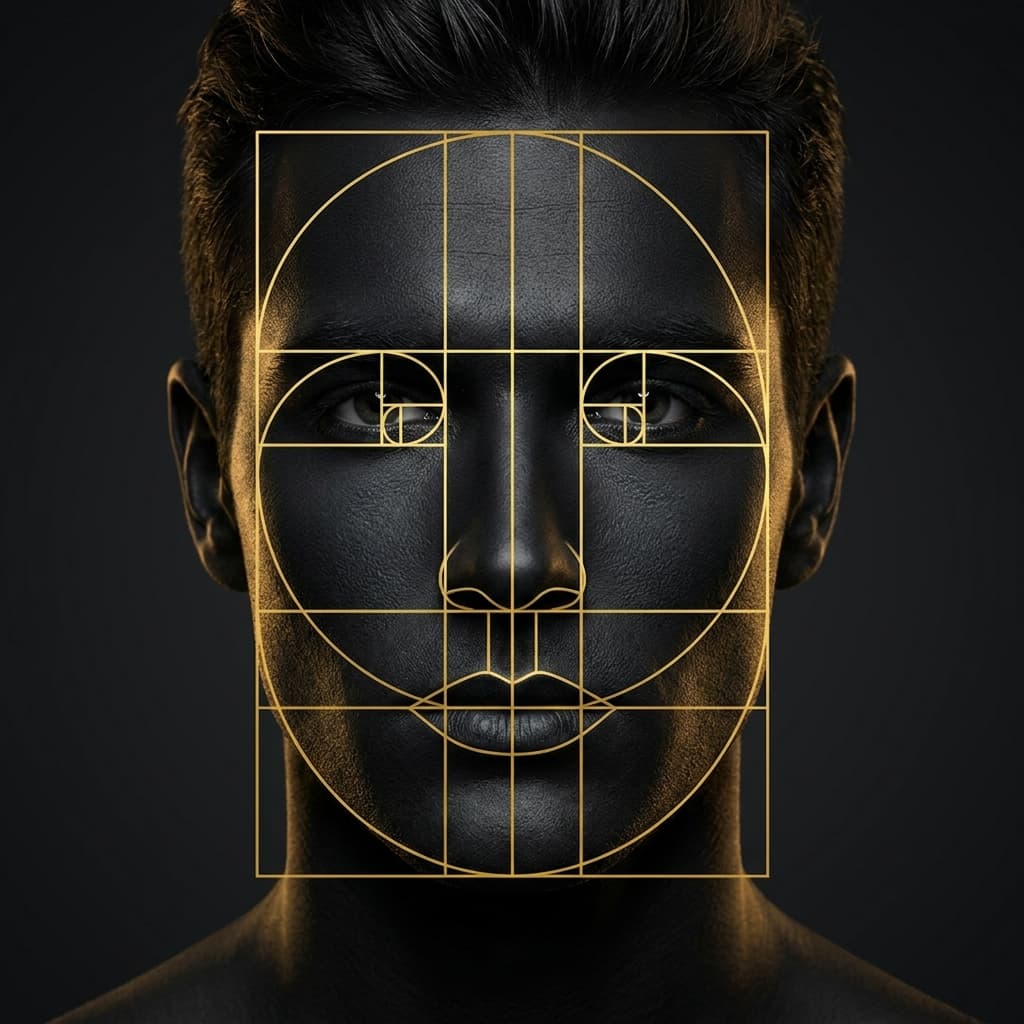
Your facial proportions track the golden ratio tightly across the board — face length-to-width, the horizontal thirds, and the feature ratios all land close to phi (1.
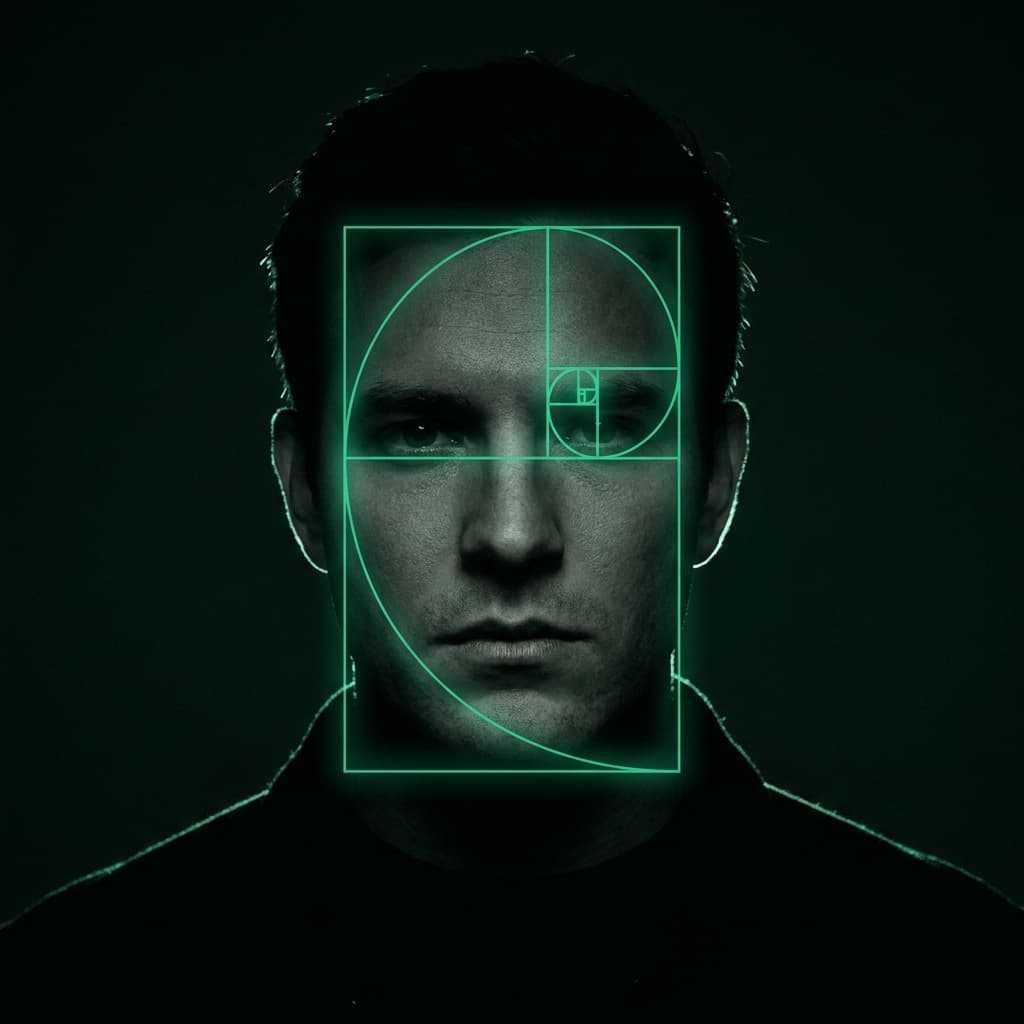
Most of your facial proportions align well with phi, with one or two that diverge and pull the composite down.
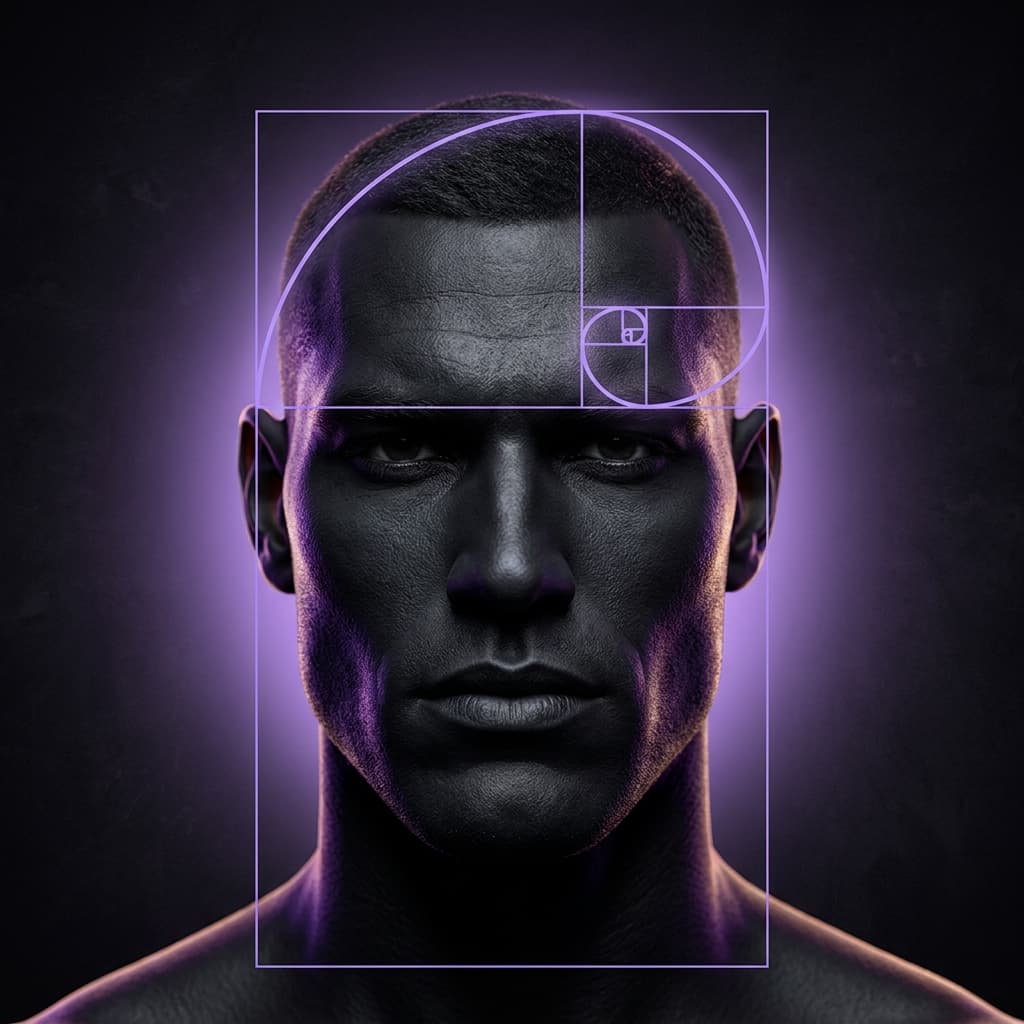
Several of your facial proportions diverge from phi.
How The Test Works
Facial landmark points are detected from your photo to locate the hairline, brow, eyes, nose, mouth, jaw, and chin — the anchors for every proportion the golden ratio cares about.
Several phi-relevant proportions are measured: face length-to-width, mouth-to-nose width, lower-face balance, pupil spacing, and eye width. Each is compared to its golden-ratio ideal (1.618 or its derivatives).
Deviations from each ideal are combined into a single 0-100 composite phi score, then bucketed into golden / harmonious / distinctive — with the three most diagnostic ratios surfaced so you see exactly what's driving the number.
What Is The Golden Ratio?
The golden ratio — phi, roughly 1.618 — is a proportion that recurs in nature, architecture, and art, from spiral shells to the Parthenon. Renaissance artists used it deliberately, and it's been linked to facial beauty for centuries: a face whose proportions approach phi is often perceived as harmonious because no single region dominates.
On a face, phi shows up in several places at once. The face is ideally about 1.618 times taller than it is wide. The width of the mouth relates to the width of the nose by phi. The vertical thirds — forehead, midface, lower face — sit in balance. When these proportions line up, the eye reads the face as 'symmetrical' or 'balanced' even though it's really registering proportion, not mirror symmetry.
It's worth being honest: the golden ratio is one model of beauty, not the whole story. Symmetry, averageness, leanness, grooming, and sexual dimorphism all matter, and many striking faces deliberately break phi. Use this as a structured way to read your proportions and find your highest-leverage lever — then run the full PSL scan to see how proportion fits alongside everything else.
The Facial Ratios We Measure
The golden ratio doesn't show up in one place on the face — it appears across several proportions at once. The composite phi score blends these five, each compared to its golden-ratio ideal. Here's what each one actually measures and why it matters:
The headline ratio. Total facial height (hairline to chin) divided by the width across the cheekbones. The phi ideal is ~1.618 — a face about 1.6x taller than it is wide. Faces that read as too wide or too long diverge here, and it's the single biggest driver of the composite score.
The width of the mouth relative to the width of the nose (across the nostrils). Phi ideal ~1.618 — the mouth roughly 1.6x wider than the nose. A wide nose or a narrow mouth both pull this below ideal; it's a key driver of lower-face harmony.
How the lower third stacks: the lip-to-chin distance against the nose-base-to-lip distance. A phi-balanced lower face avoids looking either bottom-heavy (long chin) or compressed (short chin), which strongly affects perceived jaw and chin harmony.
The distance between your pupils relative to the width of your nose. This governs how 'centered' and balanced the midface reads. Eyes set close with a wide nose, or wide-set eyes with a narrow nose, both move this away from ideal.
The classic rule that the gap between your eyes should be about one eye-width wide (a ratio near 1.0). Spacing that's noticeably tighter or wider than one eye-width is one of the most immediately noticeable proportion 'tells' to the human eye.
How To Measure Your Golden Ratio By Hand
The tool does all of this automatically in ~60 seconds, but if you want to understand what's happening — or sanity-check the result — here's the manual method on a straight, front-facing photo:
- 1
Take a front-facing photo at eye level, neutral expression, hair off the face. Open it in any app that lets you measure distances (or just use a ruler on a printout).
- 2
Measure total face height (hairline to bottom of chin) and face width (across the widest part of the cheekbones). Divide height by width — aim for ~1.618.
- 3
Measure mouth width and nose width (across the nostrils). Divide mouth by nose — aim for ~1.618.
- 4
Measure pupil-to-pupil distance and nose width. Divide pupil spacing by nose width — aim for ~1.618. Then check that your inter-eye gap is about one eye-width.
- 5
Compare each ratio to its ideal. The closer all of them sit to phi, the higher your composite score. The one furthest off is your highest-leverage lever — which is exactly what the tool surfaces for you.
Manual measurement is error-prone (a few pixels off changes the ratio), which is why the AI version uses facial landmark detection — but doing it once by hand makes the score make sense.
Golden Ratio vs Symmetry vs Averageness
The golden ratio is one of three competing scientific models of facial attractiveness, and they measure different things. Understanding the difference stops you from over-indexing on any single number — including this one.
Symmetry measures how closely the left and right halves of your face mirror each other. Averageness measures how close your features are to the mathematical average of the population (counterintuitively, 'average' faces are rated highly attractive because they signal genetic health). The golden ratio measures the proportions between features, regardless of symmetry or how typical they are. A face can score high on one and lower on another.
Most research suggests symmetry and averageness explain more of the variance in attractiveness than phi alone — but phi is the most actionable to read from a single photo and the easiest to reason about. That's why this tool gives you the phi breakdown, and why the full Mogged PSL scan layers in the other factors rather than betting everything on one model.
For Best Results
Photo conditions that take the accuracy from rough to reliable.
Shoot straight-on with the camera at eye level. Below-eye-line shots compress the lower face and inflate the width, skewing multiple ratios at once. A slight downward or upward tilt is the most common reason a score comes back lower than expected.
Pull hair off the forehead and jaw, remove glasses, and keep the full face in frame from hairline to chin. The more landmarks the model can place directly, the less it has to estimate — and estimation is where accuracy drops.
A neutral expression keeps the mouth and brow in their natural positions. Soft, even front light shows feature edges cleanly; harsh side light or backlight hides the landmarks the ratios depend on.
Facial body fat blurs the length-to-width ratio and softens jaw and cheek landmarks. If you want your structural proportions read accurately rather than your current bloat, use a recent photo at a normal-to-lean body weight.
Not Happy With Your Score?
A golden ratio score is a reading of proportion, not a verdict on your face. Three things to keep in mind before you take it to heart:
- •Check the photo first: More low scores come from a bad camera angle than bad bone structure. A below-eye-level shot can knock 10+ points off by distorting width and the lower face. Re-test front-facing at eye level before you conclude anything.
- •Find the movable ratio: Read the breakdown. If your lowest bar is a soft-tissue or framing ratio (length-to-width, thirds), leanness, hair volume, beard, and brow grooming can visibly move it. If it's a fixed bone ratio, style around it instead of chasing it.
- •Don't over-index on phi: The golden ratio is one model of harmony. Symmetry, skin, leanness, and features all matter and aren't captured here. The full Mogged scan tells you which of the 4 PSL categories is actually your bottleneck — it usually isn't pure proportion.
FAQ
What is the golden ratio for a face?+
The golden ratio (phi, ≈ 1.618) is a proportion that appears across classical ideas of facial beauty. A 'golden' face is roughly 1.618 times as long as it is wide, and several internal proportions — mouth width to nose width, the spacing of the eyes, the balance of the lower face — also approach 1.618 or its derivatives. This tool measures those proportions from your photo and scores how closely they track phi, then shows the individual readings so you can see which ones align and which diverge.
How is my golden ratio score calculated?+
The AI detects facial landmarks, measures several phi-relevant proportions (face length-to-width, mouth-to-nose width, lower-face balance, pupil spacing, eye width), compares each to its golden-ratio ideal, and combines the deviations into a single 0-100 composite score. A score of 100 means every measured ratio sits within ±3% of its phi ideal; points come off proportionally for each proportion that diverges. You get the composite score plus the three most diagnostic individual ratios.
Is the golden ratio actually scientific proof of beauty?+
It's a model, not a law. Some studies find correlations between phi-aligned proportions and perceived attractiveness; others argue the link is overstated and that averageness and symmetry explain more of the variance. Treat your score as one structured way to read facial proportions — useful for spotting which proportion stands out — not as an objective verdict on how attractive you are. Plenty of widely admired faces score well below 'golden' because a non-canonical proportion is their signature.
What's a good golden ratio score?+
Most real faces land between 55 and 85. A score of 85+ ('golden') is genuinely rare — proportions tracking phi tightly across the board. 65-84 ('harmonious') is where the majority of well-proportioned faces sit, usually with one or two divergent ratios. Below 65 ('distinctive') means several proportions diverge — characterful structure rather than 'bad.' Don't fixate on the number; the per-ratio breakdown is the useful part.
Can I improve my golden ratio?+
Partly. Some proportions are soft-tissue or presentation-driven and respond to leanness, grooming, hairstyle, beard length, brow shape, and even posture and camera angle — these can move your visible score several points. Other proportions are bone structure and effectively fixed without surgery. The breakdown is what makes this actionable: it tells you which ratio is dragging the score, so you can work on the movable ones and stop worrying about the fixed ones.
How accurate is the AI golden ratio test?+
Accuracy depends on the photo. For a straight, front-facing shot at eye level with neutral expression, landmark placement and the resulting ratios are reliable to within a few percent. Accuracy drops on tilted or turned heads, heavy filters, strong up-or-down camera angles, or partial occlusion (hair over the face, glasses). The model corrects for mild tilt, but for the most accurate read: front-facing, eye-level, soft even lighting, hair off the face.
Why is my golden ratio score lower than I expected?+
Usually one specific proportion is pulling the composite down — check the ratio breakdown to find it. Common culprits: a face that's wider than the phi length-to-width ideal (often exaggerated by facial body fat or a low camera angle), or horizontal thirds that diverge. Photo conditions matter too — a below-eye-level shot compresses the lower face and skews multiple ratios at once. Re-test with a front-facing, eye-level photo before drawing conclusions.
Does the golden ratio differ for men and women?+
The core proportions (face length-to-width ≈ 1.618, balanced thirds) apply to both, but the aesthetically 'ideal' targets differ slightly — for example, brow position, lower-face length, and jaw width read differently as masculine vs feminine even at the same phi value. This tool measures proportional adherence to phi rather than scoring you against a gendered ideal, so the score reflects geometric harmony, not a masculinity or femininity rating.
Is golden ratio the same as facial symmetry?+
No — they're different things. Symmetry is how closely the left and right halves of your face mirror each other. The golden ratio is about the proportions between features (lengths and widths), regardless of left-right symmetry. A perfectly symmetrical face can still diverge from phi, and a face with strong phi proportions can be slightly asymmetric. Both contribute to perceived harmony, which is why the full Mogged PSL scan looks at multiple factors rather than one ratio.
Is golden ratio one of the PSL categories?+
Phi proportions feed into the Harmony category of the PSL system, which is one of four categories driving the overall score. A face strongly aligned with the golden ratio tends to score well on Harmony, but Harmony alone doesn't determine your tier — skin, masculinity/features, and other factors all weigh in. Run the full PSL scan at /tools/mogger-test for the complete per-category breakdown and your actual weakest link.